You probably already know that English speakers don’t always say exactly what they mean.
Sometimes, when it makes sense to do so, we soften things. People like to avoid being too direct about awkward topics, so we make bad news sound a little better, or a little gentler. That’s where euphemisms come in.
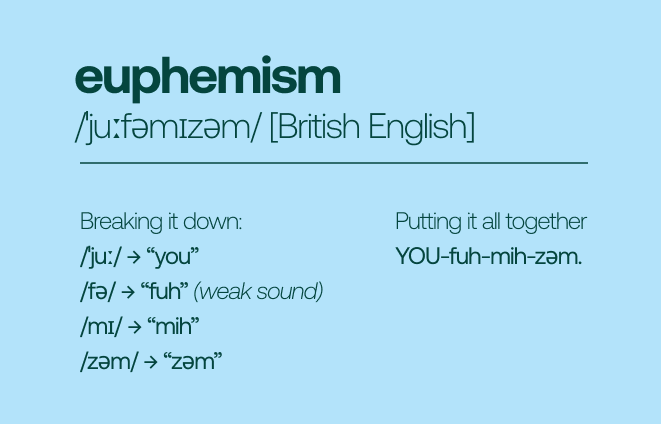
Before we get into the details, let’s look at the phonetic transcription of “euphemism”
What is a euphemism?
A euphemism is a polite or indirect word or phrase that replaces something more direct, unpleasant, or uncomfortable.
You will read or hear euphemisms everywhere, especially in movies, in the news, and in formal or professional situations.
Here’s one example:
Instead of saying: “My grandmother died.” People might say: “My grandmother passed away.”
Here, “passed away” is a euphemism for “died.”
Why do we use euphemisms?
People use euphemisms to:
Be more polite
Avoid offending people
Talk about sensitive topics (like death or money)
Sound more professional (especially at work)
You’ll start to recognise euphemisms every day, whether that’s in conversations, in class, at work, in your favourite TV show, on TikTok, or in a newspaper article.
Top tip: The next time you read or watch something, see if you can identify any euphemisms. Write down any new or interesting ones in your notebook to help you remember and learn them.
Common euphemisms in everyday English
Here are some useful euphemisms you’ll hear often, divided into different contexts:
Work and business
“Between jobs” = Unemployed
Example: “I’m between jobs at the moment.”
“Out of work” = Unemployed
Example: “She’s been out of work for a month, but I’m sure she’ll find a job soon!”
“On the job market” = Actively looking for a job
Example: “I can’t wait to graduate from university and get on the job market. I’m tired of exams!”
“Let go” = fired
Example: “He was let go last week.”
“Restructuring” = job losses are happening
Example: “The company is restructuring.”
“Role was eliminated” = Job no longer exists.
Example: “We regret to inform you that the role has been eliminated.”
“Downsizing” = Job losses are happening
Example: “I hear a rumour that the company is downsizing. Is that true?”
Death and difficult topics
“Passed away” = Died
Example: “I’m between jobs at the moment.”
“The departed” = Dead people
Example: “The ceremony honours the departed.”
“No longer with us” = Dead
Example: “He’s no longer with us.”
“Gone” = Dead
Example: “I’m so sorry to tell you this, but he’s gone.”
“Lost” = Dead
Example: “I lost my grandfather last year. He was 99.”
“Neutralised” = Killed or destroyed (Usually in a military context—you would hear this playing Call of Duty!)
Example: “The target has been neutralised. It’s safe to move in!”
“At rest” = Dead
Example: “This is a sad time, but at least my aunt is at rest now. I did not want her to suffer for a long time.”
“Gone to a better place” = Deadses are happening
Example: “I hear a rumour that the company is downsizing. Is that true?”
Relationships and personal life
“Intimate relationship” = Sexual relationship
Example: “The president admitted to having an intimate relationship with his secretary.
“Seeing someone” = Dating
Example: “She’s seeing someone new.”
“Together” = In a relationship
Example: “I didn’t know you two were together! You’re a very cute couple.”
“Sleeping together” = Sexual relationship
Example: “Have you heard the latest gossip? Marcus and Cleo have been sleeping together!”
“Called it quits” = Ended the relationship (Informal)
Example: “Marcus and Cleo have called it quits. I wonder who will get to keep the apartment.”
Age and people
“Getting on/getting up there” = Becoming old
Example: “The president admitted to having an intimate relationship with his secretary.
“Senior citizens” = Elderly people
Example: “Senior citizens get a free bus pass.”
“Seasoned” = Experienceded the relationship (Informal)
Example: “Marcus and Cleo have called it quits. I wonder who will get to keep the apartment.”
Truth and behaviour
“Economical with the truth” = not telling the truth (This can sound political or sarcastic depending on the context)
Example: “The politician was economical with the truth when asked about his most recent scandal.”
“A bit slow” = Not very intelligent (this is generally considered offensive)
Example: “He’s a bit slow sometimes.”
“Not/less than ideal” = Bad
Example: “I know I promised you a picnic, but the weather is…not ideal.”
When not to use euphemisms
Be careful! Euphemisms can sometimes be confusing, hide the truth, or come across (sound) a bit dishonest. For example: “The company is restructuring.”
Employers use this type of language to share the bad news—some people losing their jobs—with employees in a way that reduces the risk of panic.
So, with phrases like “the company is restructuring”, which means people are losing their jobs, it’s very important to think about clarity, sensitivity, and politeness.
Practice: Check your understanding
Choose the correct answer (then check your answers below)
A funeral service for the _____ will be held on Sunday.
neutralised
let go
departed
senior citizens
2. The workers protested about the recent _____ at the energy company.
between jobs
getting on
intimate relationship
lay-offs
3. Rewrite using a euphemism. Choose from options a, b, or c.
Rewrite the sentence using a euphemism:
He was fired from his job.
He was __________________________.
He was let go.
He was put off.
He was let out.
4. Think and speak! For self-study, write down and answer these questions:
Why do people use euphemisms in your country?
Can you think of a euphemism in your language?
Do you prefer direct language or softer language? Why?
Show Answers
1 – departed
2 – lay offs
3 – He was let go
30-second summary
A euphemism = a softer, more polite way to say something.
Common in work, news, and everyday conversation.
Useful, but sometimes unclear.
FAQs about euphemisms
What is a euphemism in simple English?
A euphemism is a polite or indirect way to say something that might be uncomfortable.
Why do people use euphemisms?
To be polite, avoid offence, or make difficult topics easier to talk about.
Are euphemisms always good?
Not always. They can sometimes be confusing or hide the truth.
Try a free online lesson with EC Live
Live online English classes for continuous learning.