
6 things to know before taking an adult English course abroad
The days of studying English abroad being only for young people are well over. Although it has always been...

If you’ve searched this question, you’re probably standing at one of two points: either you’re just starting out and want to know what you’re signing up for, or you’re already at B1 and B2 feels tantalisingly close.
Either way, you want a straight answer, not vague reassurance. So let’s start with one!
B2 English typically takes 500 to 600 hours of guided study to reach from a true beginner (A1) starting point, according to Cambridge English and the British Council. Studying part-time, that’s a couple of years. Studying full-time in an immersive environment, it’s closer to seven months.
At EC English Schools, our own data (tracked across our schools since 2016) shows most students progress one full CEFR level roughly every 8 weeks when studying intensively, which lines up closely with the official figures once you do the maths. We’ll show you exactly how.
This isn’t a motivational estimate. It’s a benchmark built from real assessment data, and by the end of this article you’ll know precisely what B2 requires, how long it realistically takes for someone in your position, and what actually moves the timeline, because not all study hours are created equal.
Before you can plan the journey to B2, it helps to know what you’re aiming for. B2 sits at the “Upper-Intermediate” mark on the CEFR (Common European Framework of Reference for Languages), the six-point international scale used almost everywhere in the world to describe language ability, from A1 (absolute beginner) through to C2 (near-native mastery).
At B2, you can:
In short: B2 is the level where English stops being something you’re translating in your head and starts being something you simply use. It’s also the level most universities, employers, and visa schemes treat as the practical threshold of “fluent enough.”

Because B2 is a framework rather than a specific test, it’s useful to see how it maps onto the exams you might actually sit (figures aligned with Cambridge Assessment’s exam-to-CEFR comparisons):
| B1+ → C1 | IELTS | Cambridge Exam | TOEFL | TOEIC |
| B1+ (Intermediate) | 4.5 – 5.0 | – | – | – |
| B2 (Upper-Intermediate) | 5.0 – 6.5 | B2 First (FCE) | 46 – 85 | 605 – 780 |
| B2+ (Pre-Advanced) | 6.5 – 7.5 | – | 86 – 105 | 785 – 900 |
| C1 (Advanced) | 7.5+ | C1 Advanced (CAE) | – | – |
If your target is a B2 First pass, a 6.0 on IELTS, or a TOEFL score in the mid-60s to 80s, you’re aiming at the same destination, just measured with a different ruler.
Cambridge English and the British Council have long published estimated guided learning hours, the cumulative classroom and supervised study time an average learner needs to reach each CEFR level, starting from scratch.
These figures are widely used across the language-teaching industry as the closest thing to a scientific yardstick. You can see the full breakdown directly from Cambridge English’s own guidance and the British Council’s summary of CEFR levels:
| CEFR Level | Guided learning hours (cumulative, from zero) |
| A1 (Beginner) | 90 – 100 hours |
| A2 (Elementary) | 180 – 200 hours |
| B1 (Intermediate) | 350 – 400 hours |
| B2 (Upper-Intermediate) | 500 – 600 hours |
| C1 (Advanced) | 700 – 800 hours |
| C2 (Proficiency) | 1,000 – 1,200 hours |
Two things jump out here. First, the jump from B1 to B2 requires roughly 150–200 additional hours; a similar-sized leap to every stage before it, which is worth knowing if you assumed the “upper” levels would somehow move faster.
They don’t. If anything, this stage is where a lot of learners plateau, because the easy, high-frequency vocabulary has already been learned, and progress now depends on nuance, idiom, and register.
Second (and this is the important part) these are guided learning hours, not calendar time. How long 500–600 hours actually takes you depends entirely on how those hours are structured, which brings us to the real question.
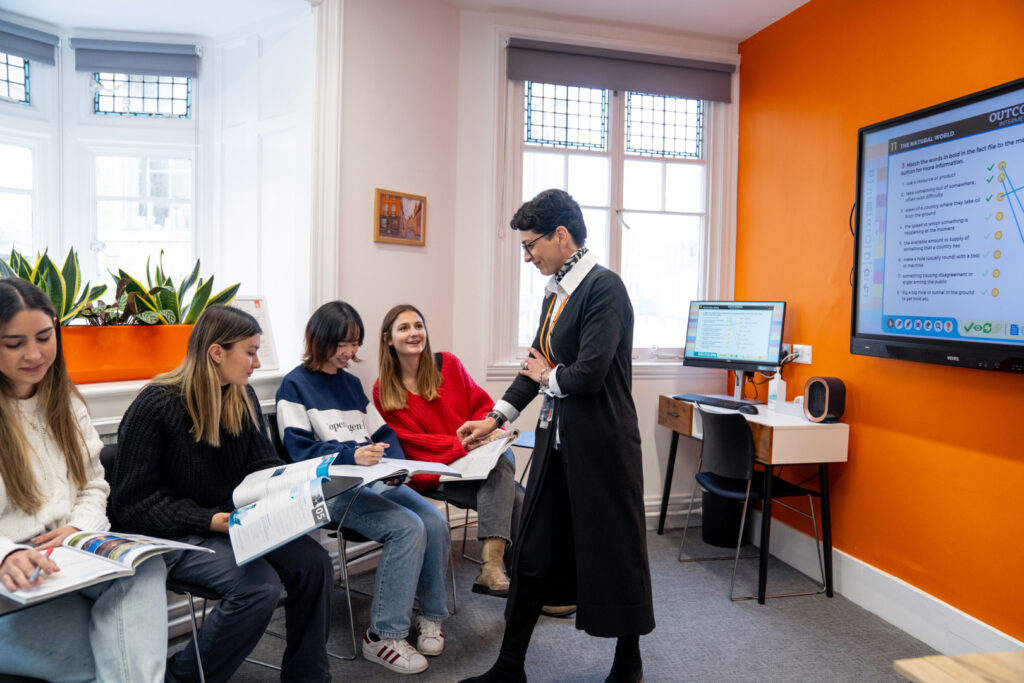
Here’s what 500–600 hours looks like at different levels of study intensity:
| Study pattern | Hours per week | Time to reach B2 from zero |
| Casual self-study (apps, occasional practice) | 2–3 hours | 4–5+ years |
| Part-time evening classes | 4–6 hours | 2–2.5 years |
| Intensive classroom course (20 hours/week) | 20 hours | ~28 weeks (7 months) |
| Full immersion (20+ hours of class plus daily English exposure) | 25–30+ hours effective | 5–6 months |
This is the single biggest lever in the entire question of “how long will this take me?” Casual, unstructured study can drag the same 500–600 hours out over half a decade — not because the learner isn’t capable, but because inconsistent exposure means constant relearning rather than steady building.
Immersive, structured study compresses the same total hours into a fraction of the calendar time, because every hour counts, and the gaps between sessions are too short for knowledge to fade.
At EC, we don’t just rely on the general industry average, we track it. Since 2016, our EC Student Analytics has monitored real student progress across our schools worldwide, and the consistent finding is that students studying intensively with EC progress approximately one CEFR level every 8 weeks.
You can see how this benchmark is applied across our courses on the EC English Courses overview and how it underpins our guarantee through the EC Promise.
Here’s what that looks like mapped across the full journey to B2, starting from an absolute beginner:
| Stage | Typical duration | Cumulative time |
| A1 → A2 | 4 weeks | 4 weeks |
| A2 → B1 | 8 weeks | 12 weeks |
| B1 → B1+ | 8 weeks | 20 weeks |
| B1+ → B2 | 8 weeks | 28 weeks (≈7 months) |
If you’re not starting from scratch, say you’re already at A2 or B1, the timeline shortens accordingly. Most students moving from Beginner (A1) to Intermediate (B1) do so in around 16–24 weeks, and the same range typically applies again moving from B1 to Advanced (C1), which places B2 comfortably in the middle of that second stretch.
It’s worth taking a moment to think about why this number holds up so well against the official Cambridge figures. 28 weeks of intensive study at roughly 20 hours a week works out to around 560 hours, landing nicely inside the independently published 500–600 hour benchmark for reaching B2.
In other words, our real-world classroom data and the industry-standard research arrive at essentially the same answer, from two completely different directions. That’s not a coincidence; it’s what happens when guided learning hours are actually delivered as guided learning hours, rather than spread thin.
Hours alone don’t guarantee progress; how those hours are taught matters just as much. Here are a few ways how EC structures learning are specifically designed to make each hour count harder than a typical part-time class anywhere else:
Every EC lesson begins with a real-life objective, works through the grammar and vocabulary needed to achieve it, and ends with you actually using that language in context, not just recognising it on a worksheet. This “use it, don’t just study it” structure is precisely what closes the gap between knowing English and being able to speak it.
Rather than an open-ended term with a single exam at the end, your course is broken into manageable four-week blocks, each with its own feedback and assessment cycle. This keeps small gaps in understanding from compounding into larger ones by the time you reach B2.
Every Friday, you reflect on the week’s progress, revisit your goals, and get direct feedback on what to work on next. Small, frequent correction loops like this are one of the most consistently effective tools in language acquisition, which is far more useful than a single grade at the end of a course.
If your progress dips below the expected trajectory, you don’t just carry on and hope… you get a 1-to-1 academic consultation, targeted support sessions, and weekly monitoring via the MyEC app to get you back on track. The 8-week benchmark isn’t a guess we hope you hit; it’s a target we actively manage you towards.
The EC Promise sets out exactly what’s expected in return for guaranteed progress: 96% class attendance, an average homework score of 9/10 across at least three assignments a week, and active lesson participation. It’s a two-way commitment: we structure the hours, you show up for them.

If you’ve spoken to anyone who’s studied English for a while, you may have heard them describe getting “stuck” somewhere around upper-intermediate level. This isn’t in your head, and it isn’t a sign you’re doing anything wrong. It’s a well-documented part of language learning, sometimes called the intermediate plateau.
Here’s why it happens.
The early stages of learning English (A1 to B1) deliver huge, visible wins. Every new week brings vocabulary you didn’t have before, grammar structures that unlock entirely new ways of expressing yourself, and conversations that were impossible a month earlier are suddenly manageable. Progress feels fast because, relative to where you started, it is.
By B2, that high-frequency, high-impact vocabulary and grammar has largely already been covered. What’s left is subtler: idiom, register, nuance, the difference between “fairly confident” and “genuinely fluent.”
These refinements matter enormously for how natural you sound, but they don’t always feel as dramatic day to day, which is exactly why this stage requires more total hours (150–200 more, per the guided learning hours table above) for what can feel like smaller, harder-won gains.
This is precisely where structure matters most. Without a clear curriculum and regular assessment, it’s easy to keep circling the same conversational ground without addressing the specific gaps holding you at B1+.
It’s also why EC builds in a Personalised Learning Plan and weekly Feedback Fridays rather than leaving learners to self-diagnose; a good teacher can spot exactly which nuance is keeping you from B2 long before you’d notice it yourself.
Guided learning hours are an average, and averages hide a lot of individual variation. A few factors genuinely move the needle:
Around 500–600 guided learning hours from an absolute beginner starting point, according to Cambridge English and the British Council. If you’re starting from B1 rather than zero, expect roughly 150–200 additional hours to close that final gap.
Yes, if you’re studying intensively (around 20–25 hours of guided instruction per week) ideally in an immersive environment. At that pace, most learners cover the equivalent of 500–600 hours in roughly 6–7 months. Part-time study of a few hours a week will take considerably longer to cover the same ground.
Based on EC’s own student data, roughly 28 weeks (about 7 months) of intensive study, progressing through A2, B1 and B1+ along the way at approximately one level per 8 weeks.
B2 is often described as “functionally fluent.” You can hold spontaneous conversations, work and study largely unassisted in English, and follow most media and professional communication, even if some nuance, idiom, and complex argumentation still belongs to C1 and beyond. For most everyday, academic, and workplace purposes, B2 is the level where English stops being a barrier.
Considerably. Guided learning hours measure classroom instruction, but immersion adds hours of informal exposure and practice that never show up in a syllabus; every conversation, every errand, every social interaction becomes additional, unstructured practice layered on top of formal study.
Because the biggest, most visible gains, like basic vocabulary, core grammar, everyday conversation, are usually secured by B1. B2 progress is about refinement: idiom, tone, and nuance, which take more cumulative hours to build but pay off in how natural and confident you sound.
C1 (Advanced) is the next stage, requiring a further 150–200 guided learning hours on top of B2, taking the cumulative total to roughly 700–800 hours. At C1, you can handle academic texts, lectures, and professional environments with accuracy and very few errors, which is the level most competitive university programmes and senior roles look for.
If someone tells you B2 is “just a few months away,” ask them how many hours a week they mean. Because that’s really the only variable that matters. The honest, data-backed answer is 500–600 guided learning hours, however you choose to spread them.
Spread thinly, that’s years. Structured properly, in an immersive environment, with consistent feedback and real accountability, it’s closer to seven months. And that’s not a sales pitch, it’s what EC’s own student data has shown consistently since 2016.
If you’re ready to stop guessing and start tracking real progress towards B2, explore EC’s General English courses or find out more about how the EC Promise guarantees your progress, level by level, every 8 weeks.
Sources:
Cambridge English – Guided Learning Hours, British Council – Our Levels and the CEFR, Council of Europe – Common European Framework of Reference for Languages,
EC Student Analytics (monitored since 2016).
Live online English classes for continuous learning.

Did you like this article? Share it!