
6 things to know before taking an adult English course abroad
The days of studying English abroad being only for young people are well over. Although it has always been...

You had the idea. The meeting was moving fast, and you could see exactly where it should go. But by the time you’d shaped the thought in English, the moment had passed. Someone else said something close. The conversation moved on.
You understood everything. You had something to say. You just couldn’t get there fast enough in the right words, with the right confidence, in English.
If that moment sounds familiar, here’s what’s actually behind it.
Only 14% of professionals who speak English as a second language say they can express themselves fully at work. That’s not a grammar statistic. It describes something more specific: the gap between the professional you are and the professional you appear to be when communicating in English under pressure.
In your native language, you’re precise, persuasive, and instinctively aware of tone. You read the room. You know when to push and when to soften. In English at work, especially in the moments that matter, a slightly flatter version of you tends to show up instead.
Researchers call this the identity gap. And it isn’t closed by more vocabulary lists or grammar revision. It’s closed by understanding what professional English actually requires and practising exactly that.
Good English communicates meaning accurately. Professional English communicates meaning in a way that moves people, builds trust, and gets things done. The difference comes down to three things.
Tone is the part of your message that carries your intention, and it’s working quietly even when you’re not thinking about it.
Compare these two versions of the same request:
“Send me the report today.”
“Would it be possible to get the report over to me today?”
Identical information. Completely different impact. In most international workplaces, the first creates friction. The second creates collaboration.
Professional English uses tone to navigate working relationships to sound confident without being demanding, direct without being blunt, polite without sounding uncertain. This is rarely covered in general English courses because it isn’t technically a grammar skill. But it shapes how you’re perceived every single day.
Grammar tells you how to construct a sentence. Structure tells you how to construct a message.
Professional messages lead with what matters most. They make the ask clear. They give the reader exactly what they need to respond, and nothing extra. A well-structured email gets actioned. One with the same words in the wrong order gets re-read, misunderstood, or ignored.
The difference is often invisible to the person writing. It’s rarely invisible to the person reading.
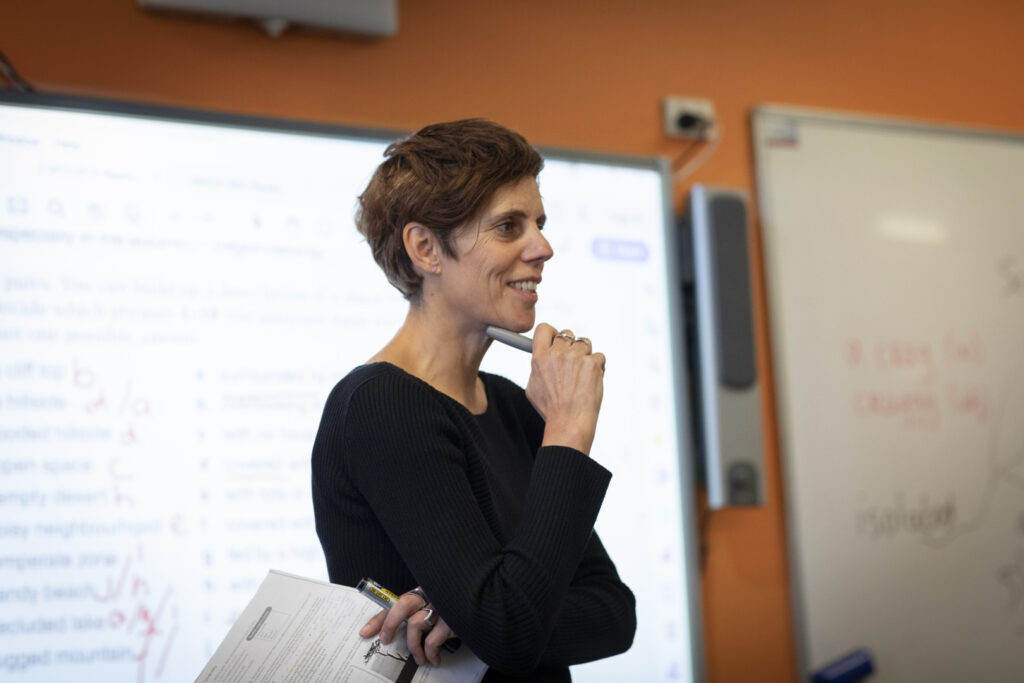
Written professional English gives you time to choose your words. Spoken professional English in meetings, on calls, presenting to clients doesn’t.
Picture this: your manager asks for your view mid-meeting. In your language, you’d answer naturally. In English, there’s a beat of hesitation – not because you don’t know what to say, but because you’re building the response in real time, in a second language, while people are watching.
The solution isn’t more grammar practice. It’s practice in real conditions; conversations that mirror actual work situations, with feedback, until the gap between thinking and speaking in professional English starts to close.
Something has quietly shifted in the last two years. Most professionals now use AI tools to help draft emails, reports, proposals, and documents. It is no longer unusual for many teams; it is simply how work gets done.
This has changed what professional writing skill actually means.
AI produces grammatically correct English quickly. What it cannot produce is your voice, your tone, your relationship with the reader, your judgment about what to say and what to leave out. The new skill is knowing how to work with AI output while keeping yourself in it: shaping the draft, adjusting the tone, and making it sound like you rather than like a template.
That combination of AI efficiency and genuine human voice is fast becoming one of the most important English for work skills a professional can develop, and it is one that almost no general English course prepares you for.
The move from good English to professional English is not a long journey. But it does require the right kind of practice focused on real communication rather than rules, on tone and structure rather than accuracy alone, and increasingly, on bringing your own voice to everything you produce, including what AI tools help you write.
When those things come together, the version of you that shows up in meetings, emails, and professional conversations gets steadily closer to the version that already exists in your own language. That is not a small thing. That is your career.
Professional English isn’t about harder grammar. It’s about clarity, tone, and confidence at work.
Our Modern Writing Skills module – part of the online English for Work series – is built for exactly this shift. From structuring professional communications to writing with AI tools while keeping your own voice intact, it covers the skills that matter in the modern workplace.

What is the difference between good English and professional English?
Good English means being understood accurately. Professional English means communicating in a way that gets results – with the right tone for the context, a clear structure that makes action easy, and the confidence to deliver your message effectively, whether in writing or in real-time conversation.
Can I improve my professional English if I’m already quite fluent?
Yes, and this surprises many people. Fluency and professional communication are related but genuinely different skills. Many highly fluent speakers still have significant room to grow in tone, assertiveness, email structure, and spoken confidence under pressure. This is exactly what focused English for work training addresses.
Why do I feel less professional in English than in my own language?
This is the identity gap: a very common experience among non-native professionals, and one that rarely gets named. It is not a language level problem. It reflects the specific communication skills that professional English requires: adjusting tone, structuring messages for impact, and speaking with confidence in real time. These are not covered in most general English programmes.
How has AI changed professional English writing?
AI tools can speed up writing and improve basic accuracy significantly. But the skill that matters professionally is knowing how to use them while keeping your own voice – editing and shaping the output so it reflects your tone and judgment, not just correct grammar.
How do I start improving my professional English for work?
The most effective path is structured practice in real workplace scenarios – meetings, presentations, emails, and professional writing. EC’s English for Work programme is built around these exact situations, with modules designed around how professionals actually communicate today.
Learn English for Work online and take your skills to the next level
Live online English classes for continuous learning.

Did you like this article? Share it!